374 sidor
På French
Publicerades 1 september 1975 av Éditions Gallimard.
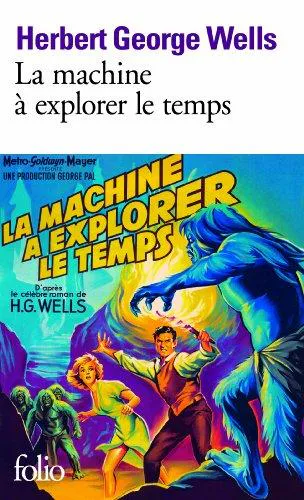
374 sidor
På French
Publicerades 1 september 1975 av Éditions Gallimard.
The Time Machine is an 1895 dystopian, post-apocalyptic, science fiction novella by H. G. Wells about a Victorian scientist known as the Time Traveller who travels to the year 802,701. The work is generally credited with the popularization of the concept of time travel by using a vehicle or device to travel purposely and selectively forward or backward through time. The term "time machine", coined by Wells, is now almost universally used to refer to such a vehicle or device. Utilizing a frame story set in then-present Victorian England, Wells's text focuses on a recount of the otherwise anonymous Time Traveller's journey into the far future. A work of future history and speculative evolution, The Time Machine is interpreted in modern times as a commentary on the increasing inequality and class divisions of Wells's era, which he projects as giving rise to two separate human species: the fair, childlike Eloi; …
The Time Machine is an 1895 dystopian, post-apocalyptic, science fiction novella by H. G. Wells about a Victorian scientist known as the Time Traveller who travels to the year 802,701. The work is generally credited with the popularization of the concept of time travel by using a vehicle or device to travel purposely and selectively forward or backward through time. The term "time machine", coined by Wells, is now almost universally used to refer to such a vehicle or device.
Utilizing a frame story set in then-present Victorian England, Wells's text focuses on a recount of the otherwise anonymous Time Traveller's journey into the far future. A work of future history and speculative evolution, The Time Machine is interpreted in modern times as a commentary on the increasing inequality and class divisions of Wells's era, which he projects as giving rise to two separate human species: the fair, childlike Eloi; and the savage, simian Morlocks, distant descendants of the contemporary upper and lower classes respectively. It is believed that Wells's depiction of the Eloi as a race living in plenitude and abandon was inspired by the utopic romance novel News from Nowhere (1890), though Wells's universe in the novel is notably more savage and brutal.
In his 1931 preface to the book, Wells wrote that The Time Machine seemed "a very undergraduate performance to its now mature writer, as he looks over it once more", though he states that "the writer feels no remorse for this youthful effort". However, critics have praised the novella's handling of its thematic concerns, with Marina Warner writing that the book was the most significant contribution to understanding fragments of desire before Sigmund Freud's The Interpretation of Dreams, conveying "how close [Wells] felt to the melancholy seeker after a door that he once opened on to a luminous vision and could never find again".
In 1933, in the preface to his collected works The Scientific Romances of H.G. Wells, Wells explained: "My early, profound and lifelong admiration for [Jonathan] Swift...is particularly evident in a predisposition to make the stories reflect upon contemporary political and social discussions." He then noted, "Mr. [Israel] Zangwill in a review in 1895 complained that my first book, The Time Machine, concerned itself with 'our present discontents'. The Time Machine is indeed quite as philosophical and polemical and critical of life and so forth, as Men Like Gods written twenty-eight years later. No more and no less. I have never been able to get away from life in the mass and life in general as disinterested from life in the individual experience, in any book I have ever written". He added later on, "The Time Machine was another assault on human self-satisfaction", being "consciously grim, under the influence of Swift's tradition".
The Time Machine has been adapted into two feature films of the same name, as well as two television versions and many comic book adaptations. It has also indirectly inspired many more works of fiction in many media productions.