Pocketbok, 638 sidor
På English
Publicerades 16 maj 2001 av Tuttle, Airlift.
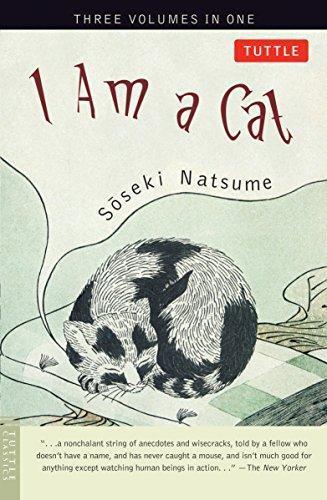
Pocketbok, 638 sidor
På English
Publicerades 16 maj 2001 av Tuttle, Airlift.
I Am a Cat (Japanese: 吾輩は猫である, Hepburn: Wagahai wa Neko de Aru) is a satirical novel written in 1905–1906 by Natsume Sōseki about Japanese society during the Meiji period (1868–1912); particularly, the uneasy mix of Western culture and Japanese traditions. Sōseki's title, Wagahai wa Neko de Aru, uses a very high-register phrasing more appropriate to a nobleman, conveying grandiloquence and self-importance. This is somewhat ironic, since the speaker, an anthropomorphized domestic cat, is a regular house cat of a teacher, and not of a high-ranking noble as the manner of speech suggests.
The book was first published in ten installments in the literary journal Hototogisu. At first, Sōseki intended only to write the short story that constitutes the first chapter of I Am a Cat. However, Takahama Kyoshi, one of the editors of Hototogisu, persuaded Sōseki to serialize the work, which evolved stylistically as the installments progressed. Nearly all the …
I Am a Cat (Japanese: 吾輩は猫である, Hepburn: Wagahai wa Neko de Aru) is a satirical novel written in 1905–1906 by Natsume Sōseki about Japanese society during the Meiji period (1868–1912); particularly, the uneasy mix of Western culture and Japanese traditions.
Sōseki's title, Wagahai wa Neko de Aru, uses a very high-register phrasing more appropriate to a nobleman, conveying grandiloquence and self-importance. This is somewhat ironic, since the speaker, an anthropomorphized domestic cat, is a regular house cat of a teacher, and not of a high-ranking noble as the manner of speech suggests.
The book was first published in ten installments in the literary journal Hototogisu. At first, Sōseki intended only to write the short story that constitutes the first chapter of I Am a Cat. However, Takahama Kyoshi, one of the editors of Hototogisu, persuaded Sōseki to serialize the work, which evolved stylistically as the installments progressed. Nearly all the chapters can stand alone as discrete works.
In the mid-1970s, the prolific screenwriter Toshio Yasumi adapted Sōseki's novel into a screenplay. Kon Ichikawa directed the film, which premiered in Japanese cinemas in 1975. The novel was also adapted into a film released in 1936, and an anime television special aired in 1982.