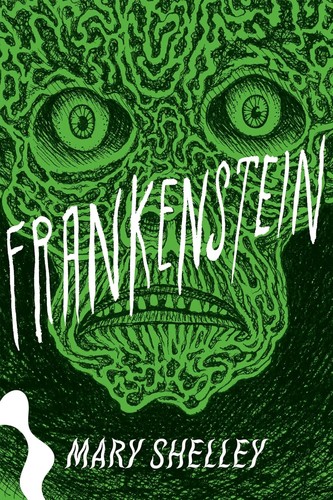
It's been a long time since I read the 1831 edit, so I can't really compare them. But a few thoughts:
Fittingly for Frankenstein, the author is both alive and dead. "Mary Shelley (with Percy Shelley)". Because heaven forfend we think a teenage girl wrote this completely on her own, practically inventing the entire SF genre, with no influence from any editor, or that married couples with the same profession help each other out. The Lone GeniusTM is, after all, male; we will never see a critical edition published as "Paul Auster (with Siri Hustvedt)" or "Stephen King (with Tabitha King)", but the merest suggestion that Harper Lee let Capote read To Kill A Mockingbird before publication and we can all assume that he really wrote it, amirightfolks? That said, having PBS's contributions clearly marked is interesting, and confirms that he was more an editor than a co-creator; sometimes he just adds purple prose, sometimes he helps her clarify themes, but at no point does he seem to invent anything that wasn't already there.
Frankenstein discovered that I detailed or made notes concerning his history; he asked to see them, and himself corrected and augmented them in many places, but principally in giving the life and spirit of the conversations he held with his enemy.
The enemy, the adversary, the creator, the monster. Everybody knows that Frankenstein is the scientist, not the monster. Except he kind of is. Whatever Mary Shelley's intended moral of the story, Victor Frankenstein doesn't come across as a very good man. He creates a feeling, intelligent, moral creature in his image, and when he finds it repugnant, abandons and rebukes it until it lashes out. (And I totally just called Adam "it", didn't I?) At no point does he accept responsibility, yet he feels guilt. He claims to refuse the demands made upon him by his creation for the greater good of humanity, yet he's so self-centered that when the monster whose entire strategy so far has been to kill his family to make him suffer tells him he'll "see him on his marriage night", Frankenstein never once considers that the threat might not be on HIS life. Hell, up until the epilogue, you could easily claim that the monster only exists in his imagination. He's the narrator, he's the Man, he's the Hero; of course everything is about him, and when his fiancée drops very unsubtle hints that she'd like to have her own adventures while she waits for him to settle down, he doesn't even notice it. That's not to say that the monster isn't monstrous either, of course; but she does give him several chances to accuse his creator and defend his own actions, while admitting that they are monstrous. Throughout the novel, as much as they try to accuse the other, the lines between them blur.
The Swedish word "mönster" means "pattern". The German word "Münster" means "church". Of course there's a lot of romantic/proto-existentialist playing around with Man vs God here, and Shelley leaves it all wonderfully open-ended; the power balance between creator and creature (etymology!) shifts around, they demand answers and actions of each other that the other cannot give; at the end of Frankenstein wait both Nietzsche and Sartre; the zeitgeist has started accusing God, contemplating His death, but finds the idea both unavoidable and horrific. The Monster is too eloquent; he's learned all this philosophy, and none of it helps him any when Victor simply says "no". Shelley's dynamic duo of Victor and Adam go to their deaths lamenting that they no longer have a reason to live when the other is no longer there to be accused, interrogated, tortured until they accept responsibility, but neither actually kills the other.
My person was hideous, and my stature gigantic. What did this mean? Who was I? What was I? Whence did I come? What was my destination? These questions continually recurred, but I was unable to solve them.
Of course, most adaptations and more-or-less outright thefts of the story try to simplify it, as if to create much clearer demarcations between Good and Evil; make Frankenstein himself a simple mad scientist with an Igor, and the monster a nearly-mute beast, far from Shelley's constantly orating philosophy student. Introduce a real hero and a few villagers with pitchforks to do the dirty work. Yet in Bride of Frankenstein (the first sequel, confirming that the Monster was simply too cool to not be kept alive through a thousand reincarnations) when the monster kills his creator, the only two characters who remain through all versions, his last immortal words are "WE BELONG DEAD!". "We". And so the author (and reader) remains both alive and dead.