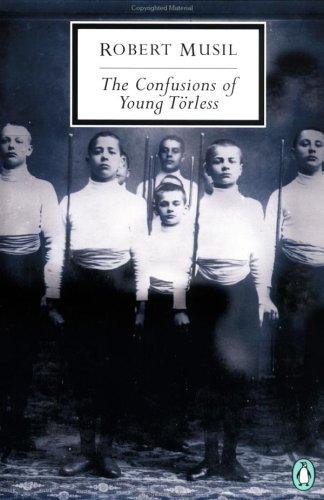

Björn recenserade The Confusions of Young Törless (Penguin Twentieth-Century Classics) av Robert Musil (Penguin twentieth-century classics)
None
4 stjärnor
If they were to ask him, why did you abuse Basini?, he could hardly answer them: because I was constantly interested in something happening in my mind, a something, which so far I know very little about and which makes everything I think about seem pointless.
Three boys at yer stereotypical turn-of-the-century boarding school get caught up in yer stereotypical turn-of-the-century philosophical quandaries, and take it out on a fourth boy by beating, harrassing and raping him. Yes, this was written in 1906. And besides, there's nothing gay about raping a boy; it's only when you start feeling something that you need to do something about it, when the disconnect between body and mind becomes too hard to handle, that you need to really victimize him to make sure you can tell yourself he deserves it.
If that sounds flippant, it's not meant to be. Much of what Musil would …
If they were to ask him, why did you abuse Basini?, he could hardly answer them: because I was constantly interested in something happening in my mind, a something, which so far I know very little about and which makes everything I think about seem pointless.
Three boys at yer stereotypical turn-of-the-century boarding school get caught up in yer stereotypical turn-of-the-century philosophical quandaries, and take it out on a fourth boy by beating, harrassing and raping him. Yes, this was written in 1906. And besides, there's nothing gay about raping a boy; it's only when you start feeling something that you need to do something about it, when the disconnect between body and mind becomes too hard to handle, that you need to really victimize him to make sure you can tell yourself he deserves it.
If that sounds flippant, it's not meant to be. Much of what Musil would perfect (in an imperfect, meandering way) in The Man Without Qualities is already here, and even if Törless has his moments of whiny Holden Caulfieldity, those stereotypical proto-Nietzsche/Dostoevsky/etc ponderings are certainly worth reading again and Musil has a healthy distance to his protagonist.