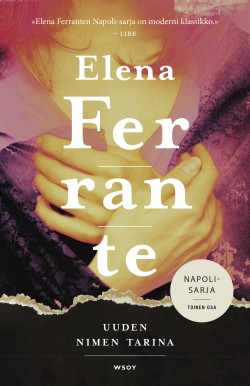

Björn recenserade The story of a new name av Elena Ferrante (Neapolitan novels, #Book two)
None
5 stjärnor
In which Lila gets married and falls in love (not in that order), and Elena tries even harder to pretend she's just the objective chronicler.
The only woman's body I had studied, with ever-increasing apprehension, was the lame body of my mother, and I had felt pressed, threatened by that image, and still feared that it would suddenly impose itself on mine. That day, instead, I saw clearly the mothers of the old neighborhood. They were nervous, they were acquiescent. They were silent, with tight lips and stooping shoulders, or they yelled terrible insults at the children who harassed them. Extremely thin, with hollow eyes and cheeks, they lugged shopping bags and small children who clung to their skirts and wanted to be picked up. And, good God, they were ten, at most twenty years older than me. Yet they appeared to have lost those feminine qualities that were so …
In which Lila gets married and falls in love (not in that order), and Elena tries even harder to pretend she's just the objective chronicler.
The only woman's body I had studied, with ever-increasing apprehension, was the lame body of my mother, and I had felt pressed, threatened by that image, and still feared that it would suddenly impose itself on mine. That day, instead, I saw clearly the mothers of the old neighborhood. They were nervous, they were acquiescent. They were silent, with tight lips and stooping shoulders, or they yelled terrible insults at the children who harassed them. Extremely thin, with hollow eyes and cheeks, they lugged shopping bags and small children who clung to their skirts and wanted to be picked up. And, good God, they were ten, at most twenty years older than me. Yet they appeared to have lost those feminine qualities that were so important to us girls and that we accentuated with clothes, with makeup. They had been consumed by the bodies of husbands, fathers, brothers, whom they ultimately came to resemble, because of their labors or the arrival of old age, of illness. When did that transformation begin? With housework? With pregnancies? With beatings?
I was just talking to a friend about the original title of part 1; L'amica geniale, a title that the English title ("My brilliant friend") comes close to and the Swedish ("My fantastic friend") nowhere near. Of course, Lila is very much portrayed as a genius - or a "Mary Sue", if you will, that phrase that gets trotted out any time a fictional female character manages to walk in a straight line without falling over. Lila, from childhood through early adulthood, seems able to do anything better than anyone else, or at least better than her biographer - but only once, before getting bored of it. At the same time, of course, genial she's not, and who can blame her? Part 2 is one long lesson in how the world would work for a poor, uneducated, working-class, beautiful girl in a man's world; anything she does or has done to her just limits her opportunities, and she's smart enough to see it, but powerless to do anything about it except act out in ways that dig her in deeper. She stops reading because it's always the same story: inside something small there's something even smaller that wants to leap out, and outside something large there's always someting larger that wants to keep it a prisoner. When she starts back up - pulled by the promise of a way out - Ferrante seems to deliberately echo this picture:
As much as the book claims to be about Lila, though, it says as much about Elena, always comparing herself to her friend even as Lila's life goes horribly but, thanks to Elena, Shakespeare-tragically off the rails, and coming up short, hating and loving the other woman for making her a part of it or not. Elena, and the readers, are pulled in by Lila's (mis)fortunes, unable to not keep projecting; perhaps that's the reason for all those tiresome Knausgård comparisons, whereas KOK deliberately writes as vaguely about his feelings as possible so that anyone can recognize themselves in it, Elena seems at first like the passive observer we can all see through vicariously, and only gradually you see the angles she herself brings to the story - not so much an unreliable narrator as a narrating unreliable human being.
I zip through this in days. The writing is stunning, the portrait of women turning against each other as their choices become fewer and fewer, the hunger for something else whether it be found in love, sex, violence or learning, the way it effortlessly captures a time that seems historical by now but still is only a thin layer of dust away from today... Bring on part III.