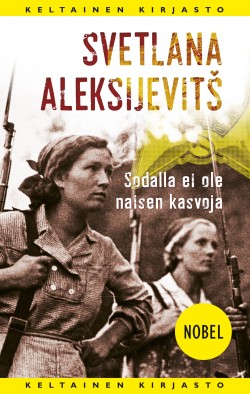
Björn recenserade Kriget har inget kvinnligt ansikte av Svetlana Aleksijevitš (Utopins röster)
None
5 stjärnor
"I want you to know that they stole victory from us."
As always with Alexievich, it's made up of individual stories, lots of little moments of history.
She who followed her husband into war because they couldn't bear to be apart, and fought at his side until he fell.
We held our wedding in a trench, right before a battle. I made myself a white dress from a German parachute.
She whose fellow male soldiers had to explain to their superiors why they needed more t-shirts, the female soldiers had stolen theirs and ripped them up. Why? Why on earth would female soldiers need extra rations of cotton once a month? Um... well, see, Lieutenant...
She who had an abortion to be able to go to war, and avenged her unborn child with every German she killed.
She who returned from the war, only to realise her own mother didn't …
"I want you to know that they stole victory from us."
As always with Alexievich, it's made up of individual stories, lots of little moments of history.
She who followed her husband into war because they couldn't bear to be apart, and fought at his side until he fell.
We held our wedding in a trench, right before a battle. I made myself a white dress from a German parachute.
She whose fellow male soldiers had to explain to their superiors why they needed more t-shirts, the female soldiers had stolen theirs and ripped them up. Why? Why on earth would female soldiers need extra rations of cotton once a month? Um... well, see, Lieutenant...
She who had an abortion to be able to go to war, and avenged her unborn child with every German she killed.
She who returned from the war, only to realise her own mother didn't recognize her. She who returned home and was cast out as a whore, because everyone knows what women do at the front. She who returned home and only found a mass grave where there'd been a village and had to dig through rotting corpses to find her family.
When I returned from the front, my sister showed me a grave ... They'd buried me.
She who saw her fellow soldiers rape their way through Germany and many years later still didn't know how she felt about it after what the Nazis did to her own family.
She who always carried two extra bullets because she knew the enemy considered female soldiers spoils of war.
They'd impaled her on a stake ... The frost had come, and she was all white and her hair grey. She was nineteen. In her backpack we found letters from home and a green rubber bird. A toy.
She who let her seven-year-old daughter carry a bomb inside the German HQ in a food basket.
And on and on and on, the ones who 40 years later tell a journalist what happened to them, and often begin with some variation on "My husband told me to just talk about troop movements and bravery, so you're probably not interested in what I have to say, but is it OK if I just talk a bit about how it feels to go to war?" She who listens, takes notes, passes along, tries to get them to tell their own stories and not just repeat the same old Great Patriotic War heroisms.
In the late 70s, Svetlana Alexievich started travelling the Soviet Union, interviewing a few hundred of the millions of women who took part in WWII. Yes, they were there, even if their story had never been told; farmer's daughters, schoolgirls and wives who more or less voluntarily served as nurses, cooks, sharpshooters, infantry soldiers, pilots, engineers, telegraphists... Only to return home and, best case scenario, were told "There, honey, now don't worry your pretty head about that nasty business again, go sit down and take care of your man like a proper woman if you still remember how after wearing pants for so long." Who've carried it all for 40 years without anyone asking about it.
Taken one by one, the stories become little novellas spanning from the prosaic ("Four years in men's underwear!") to the deeply tragic. When Alexievich puts them all together, they become something entirely different, a choir of voices, often identified only by first name and rank, finally telling what they went through during one of the bloodiest wars in history, and of the other war they've had to live with since. Superior officers who hide behind chivalry and protectiveness so they don't have to treat them as equals, fellow soldiers who admit that yeah, she's almost as good as a man and I owe her my life, but who wants a wife who's almost a man?, a society that expects them to make sacrifices with no thought of reward or recognition while the men who do the same thing are treated as heroes. The complete edition of the book adds another layer by including and noting the sections that were excised in the 80s, including the censor's comments on why they must be stricken. Only now, when most of the participants are dead, do they get to speak freely. In a Soviet society where everyone was equal, the great patriar... sorry, patriotic war couldn't be presented as womanlike twaddle about feelings, that would imply that something had been excluded from the official story. No, the esteemed censor becomes downright offended on behalf of the poor old women who don't know when to keep their mouths shut.
Who'd be prepared to fight a war after reading something like that? Your primitive naturalism is a slap in the face of womankind. And of the female war heroes. You dethrone them. Turn them into ordinary women, into bitches. They must be held sacred.
Which I guess is a rave review as good as any.