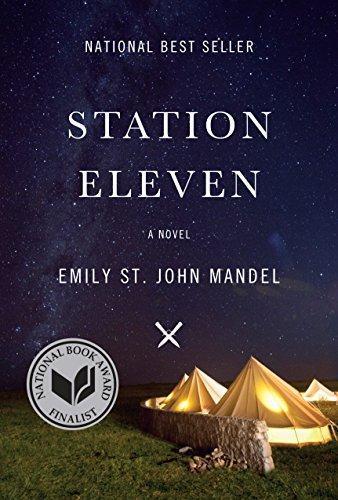
Station Eleven is a 2014 novel by Emily St. John Mandel, her fourth. It takes place in the Great Lakes region before and after a fictional swine flu pandemic, known as the "Georgia Flu", has devastated the world, killing most of the population. It won the Arthur C. Clarke Award in 2015.The novel was well received by critics, with praise emphasizing the understated nature of Mandel's writing. It appeared on several end-of-year best novel lists. By 2020 it had sold 1.5 million copies.
Station Eleven is a 2014 novel by Emily St. John Mandel, her fourth. It takes place in the Great Lakes region before and after a fictional swine flu pandemic, known as the "Georgia Flu", has devastated the world, killing most of the population. It won the Arthur C. Clarke Award in 2015.The novel was well received by critics, with praise emphasizing the understated nature of Mandel's writing. It appeared on several end-of-year best novel lists. By 2020 it had sold 1.5 million copies.
a fairly good read in parts, kind of tedious in others. The character that links together all the other pivotal characters was mediocre and pathetic and so much of the book is devoted to the most banal aspects of contemporary life. I think I would rather have read the graphic novel that's at the center of the story but remains mostly undeveloped.
a fairly good read in parts, kind of tedious in others. The character that links together all the other pivotal characters was mediocre and pathetic and so much of the book is devoted to the most banal aspects of contemporary life. I think I would rather have read the graphic novel that's at the center of the story but remains mostly undeveloped.
Of course everyone is sick of dystopias. And almost as sick of postapocalypses. And yet somehow this really works.
She takes us quickly through the boring bit; from an actor having a heart attack on stage during King Lear in Toronto, to an audience member being told there's a new superflu in town, to the end of the world as we know it, all in the first 35 pages, without any scenes of mass hysteria. Then it's 20 years later, 99.9% of the world's population has died, but the worst death throes of society have passed and things are starting to resemble some form of order again. We join up with a small theatre troupe travelling from settlement to settlement, performing Beethoven and Shakespeare. Because nobody wants to remember too much of the modern world when the height of available technology is the odd gun.
Except: 1. It's not that …
Of course everyone is sick of dystopias. And almost as sick of postapocalypses. And yet somehow this really works.
She takes us quickly through the boring bit; from an actor having a heart attack on stage during King Lear in Toronto, to an audience member being told there's a new superflu in town, to the end of the world as we know it, all in the first 35 pages, without any scenes of mass hysteria. Then it's 20 years later, 99.9% of the world's population has died, but the worst death throes of society have passed and things are starting to resemble some form of order again. We join up with a small theatre troupe travelling from settlement to settlement, performing Beethoven and Shakespeare. Because nobody wants to remember too much of the modern world when the height of available technology is the odd gun.
Except: 1. It's not that straightforward. St John Mandel keeps flashing back, following up on that actor, on his friends and lovers, on what happened in those days and months and years in between, because people are still connected through blood, through memories, through shared experiences, and just because some of them have been dead for 20 (or 400) years doesn't mean they're out of the picture. 2. While she doesn't shy away from the horror, the whole book is shot through with other emotions. Grief, both for the people lost and the world lost, that haunts everyone. Wonder at what they once had, and what they still do. Curiosity at what the world was like, for the younger ones.
The Shakespeare company carries a Star Trek quote on their wagons. SURVIVAL IS INSUFFICIENT.
There are bits here that read like a pitying pat on the head to The Road; people are better than that, well, most people are, and the ones obsessed with carrying the fire aren't necessarily the best ones. We cannot bear savagery, we default to cooperation. It's a Canadian novel.
When you kill someone, as you almost inevitably have to in this situation, you get yourself a tattoo. Not on your face to scare others, but on your hand to remind yourself of what it has done.
Yes, some of the connections are far too coincidental. But the dreamy, sorrowful, hopeful tone of the book lets me accept it. As if disaster demands providence too - not necessarily that of a god, but that of a narrator.