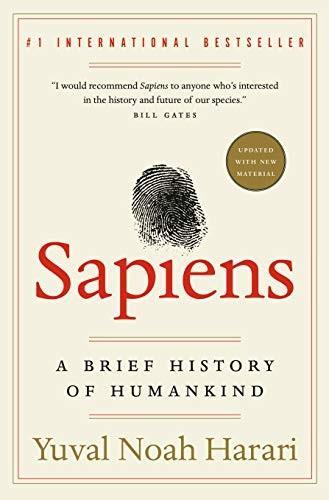
Destined to become a modern classic in the vein of "Guns, Germs, and Steel," "Sapiens" is a lively, groundbreaking history of humankind told from a unique perspective. 100,000 years ago, at least six species of human inhabited the earth. Today there is just one. Us. "Homo Sapiens." How did our species succeed in the battle for dominance? Why did our foraging ancestors come together to create cities and kingdoms? How did we come to believe in gods, nations, and human rights; to trust money, books, and laws; and to be enslaved by bureaucracy, timetables, and consumerism? And what will our world be like in the millennia to come? In "Sapiens," Dr. Yuval Noah Harari spans the whole of human history, from the very first humans to walk the earth to the radical -- and sometimes devastating -- breakthroughs of the Cognitive, Agricultural, and Scientific Revolutions. Drawing on insights from biology, …
Destined to become a modern classic in the vein of "Guns, Germs, and Steel," "Sapiens" is a lively, groundbreaking history of humankind told from a unique perspective.
100,000 years ago, at least six species of human inhabited the earth. Today there is just one.
Us.
"Homo Sapiens."
How did our species succeed in the battle for dominance? Why did our foraging ancestors come together to create cities and kingdoms? How did we come to believe in gods, nations, and human rights; to trust money, books, and laws; and to be enslaved by bureaucracy, timetables, and consumerism? And what will our world be like in the millennia to come?
In "Sapiens," Dr. Yuval Noah Harari spans the whole of human history, from the very first humans to walk the earth to the radical -- and sometimes devastating -- breakthroughs of the Cognitive, Agricultural, and Scientific Revolutions. Drawing on insights from biology, anthropology, palaeontology, and economics, he explores how the currents of history have shaped our human societies, the animals and plants around us, and even our personalities. Have we become happier as history has unfolded? Can we ever free our behaviour from the heritage of our ancestors? And what, if anything, can we do to influence the course of the centuries to come?
Bold, wide-ranging and provocative, "Sapiens" challenges everything we thought we knew about being human: our thoughts, our actions, our power...and our future.
This book should be mandatory reading. It explains many things in a simple way and reads like a thriller, despite being a history book. It just makes sense. So do yourself a favour and read it. now.
It bugs me how much I end up disliking this book. Initially it's brilliant, taking the history of humanity and flipping it to present Homo Sapiens Sapiens as, if not nothing but, then certainly to a large extent a carrier of memes, myths, genes, and even other species. The idea that we didn't consciously decide to settle down and eat grass for all time but that wheat essentially hijacked us to spread across the globe is an intriguing one, and he takes a long-term view of human history that certainly casts ideas about free will etc into a much dimmer light. It feels a lot like a companion piece to Lasse Berg's Dawn Over The Kalahari and its sequels, which I loved.
But then... he just gets lost. The trouble with a view like this is that he takes it as licence (there's human nature for ya) to apply it …
It bugs me how much I end up disliking this book. Initially it's brilliant, taking the history of humanity and flipping it to present Homo Sapiens Sapiens as, if not nothing but, then certainly to a large extent a carrier of memes, myths, genes, and even other species. The idea that we didn't consciously decide to settle down and eat grass for all time but that wheat essentially hijacked us to spread across the globe is an intriguing one, and he takes a long-term view of human history that certainly casts ideas about free will etc into a much dimmer light. It feels a lot like a companion piece to Lasse Berg's Dawn Over The Kalahari and its sequels, which I loved.
But then... he just gets lost. The trouble with a view like this is that he takes it as licence (there's human nature for ya) to apply it to everything, and the latter two thirds of the book basically feel like you're sitting in the back seat of a very talkative cab driver who's Figured It All Out and needs to tell you about it. Blah blah hunter-gatherers, blah blah capitalism, blah blah human rights is a sham, blah blah blah. He makes some interesting points, and I kinda like the irony that a book that starts out trying to say something about Homo Sapiens as a whole ends up saying at least as much about Yuval Harari in particular, but damn this book became a chore quickly.