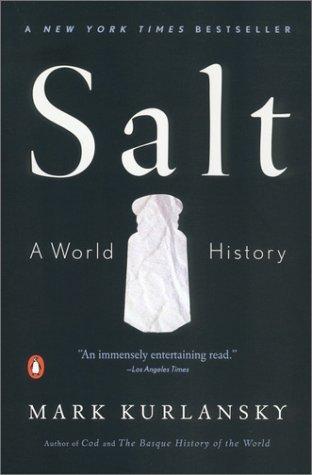
Björn recenserade Salt: A World History av Mark Kurlansky
None
3 stjärnor
My mother, like many a retired teacher, has opinions. One of them: schools should - at least some of the time - co-ordinate their classes to fit a theme. For instance, food, one of the basic 4 F:s of survival (Feeding, Fighting, Fleeing and Mating). Everybody, regardless of background and situation, has to eat. So why not have schools take a week or two out of each year and have different classes focus on their angle on the how we consume energy. Why do we eat? What do we eat? What happens to us when we eat different things? Why do we eat different things in different parts of the world? How has what we eat, and how we get it, shaped our history, our economy, our wars, our trade routes, our language, our cultures, our literature, our very geography and climate? What are our options, food-wise, when the world …
My mother, like many a retired teacher, has opinions. One of them: schools should - at least some of the time - co-ordinate their classes to fit a theme. For instance, food, one of the basic 4 F:s of survival (Feeding, Fighting, Fleeing and Mating). Everybody, regardless of background and situation, has to eat. So why not have schools take a week or two out of each year and have different classes focus on their angle on the how we consume energy. Why do we eat? What do we eat? What happens to us when we eat different things? Why do we eat different things in different parts of the world? How has what we eat, and how we get it, shaped our history, our economy, our wars, our trade routes, our language, our cultures, our literature, our very geography and climate? What are our options, food-wise, when the world changes? How has food changed between when the teacher was a kid and what the kids eat now? Etc. She argues it would not only show kids a practical application of all the stuff they learn, but also - hopefully - teach them to think about the effect they have on the world and on each other.
While I'm not entirely convinced it's practical (don't tell her that), I like the idea, and when I stumbled over Salt it seemed to scratch that idea: a history of one of THE most basic ingredients there is. Salt is one of the oldest trade goods there is, it's something we need to eat in small doses, it's something that's enabled us to store food for months so we can survive without resorting to hunting-gathering, it's something that we've always needed to organise in order to get at since you very rarely find it pure and easily accessible... Access to salt has triggered revolutions and helped decide wars, excess of salt has caused pandemics of ill health, we use it for everything from making food yummy to preventing death on icy roads. Surely that should be enough fodder for a really intriguing book?
Well, yes and no. There's no faulting Kurlansky's research, and if it's salt you want to know about, you'll get your fill; from ancient Chinese and Celtic mining techniques to life for the few people who still live on Caribbean islands whose salt production shut down in the 60s, from the original recipes for garum and soy sauce to the history of Tabasco, from thrifty salt tycoons who sprang up during the US revolutionary war to Swedish salt liquorice (for which I apologize to the entire world on behalf of my countrymen), and a lot of very complex recipes... Gandhi is in it, as are Louis XIV and Aristotle, Lot's Wife and a ton of nameless pigs and herrings. And yes, it comes across a bit like a Troy McClure documentary (Salt! The other white powder!) at times, but hey, no one will complain that Kurlansky isn't interested in his subject.
Unfortunately, it's also both a bit messy - there's no real through line to it, either chronological or topical - and at times a bit myopic. At times he gets so carried away with talking about salt that he forgets to put it in a wider context; you get the impression that salt is not just an important good but the ONLY important good, and that, for instance, lack of salt was the determining factor in, say, the US civil war. If he'd collaborated with a keen historian, there might have been more to this book.
As it is, though, it'll certainly leave you with an awful lot of anecdotes about salt. And a howling urge to pickle things.