Amanda recenserade Jerusalem av Alan Moore
Review of 'Jerusalem' on 'GoodReads'
1 stjärna
I really tried, but I couldn't finish. This book needs an editor, badly.
I really tried, but I couldn't finish. This book needs an editor, badly.
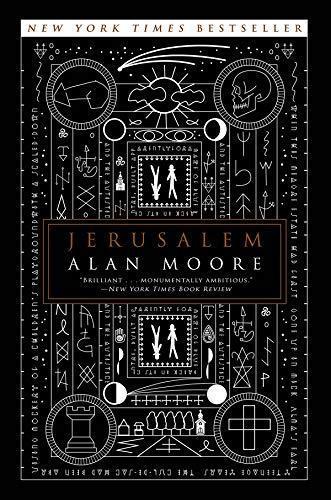
Pocketbok, 1280 sidor
På English
Publicerades 30 juli 2018 av Liveright.
I really tried, but I couldn't finish. This book needs an editor, badly.
I really tried, but I couldn't finish. This book needs an editor, badly.
Alan Moore's new novel - only his second "real" novel, if you discount things like Watchmen, V For Vendetta, From Hell and all those things that are Just Comic Books - is 1266 pages long, in three volumes, and took him ten years to write. It spans from the ice age to the end of the world. It has dozens, maybe hundreds, of POV characters, fictional or real, living or dead. It switches styles with almost every chapter and jumps from highbrow literary games to furious politics, from kitchen-sink realism to pure fantasy, and more than once all of those at the same time.
Alan Moore's new novel takes place over two days - 26 and 27 May 2006 - in what remains of Northampton's old working-class quarters after the demolitions in the sixties, a community reduced to hopelessness, where a man is going to an exhibit of …
Alan Moore's new novel - only his second "real" novel, if you discount things like Watchmen, V For Vendetta, From Hell and all those things that are Just Comic Books - is 1266 pages long, in three volumes, and took him ten years to write. It spans from the ice age to the end of the world. It has dozens, maybe hundreds, of POV characters, fictional or real, living or dead. It switches styles with almost every chapter and jumps from highbrow literary games to furious politics, from kitchen-sink realism to pure fantasy, and more than once all of those at the same time.
Alan Moore's new novel takes place over two days - 26 and 27 May 2006 - in what remains of Northampton's old working-class quarters after the demolitions in the sixties, a community reduced to hopelessness, where a man is going to an exhibit of paintings his sisters based on something he may have dreamed as a kid, while a young crack whore in one of the other houses is about to finally lose her grip on life once and for all. They're the POV characters.
Yes, in some of its many, many dimensions, Jerusalem is a simple story, a love letter to Moore's home town and a raised middle finger to everything it's put up with since the Romans, but he takes the scenic route there. James Joyce once said that if Dublin were destroyed, you could recreate it based on the detail in Ulysses. Moore took that to heart, except he's not happy with just capturing Northampton on that one day; cities are living creatures, and people, buildings and ideas that disappeared ages ago still leave traces. So he has to tell the story in four dimensions, time and space, reality and dreams. He has to pull in angels (sorry, angles - four dimensions, remember?) and devils, fires and invasions, New Labour and theodicy, creativity and madness, moral responsibility in a world without free will ("Did you miss it?"), death and immortality until he's included EVERYTHING. And all these stories that he weaves together, like a giant snooker game where every ricochet changes the whole game and every ball is worth just as many points. This long line of characters from all ages and situations, who at first have nothing in common but the fact that they happen to live (or not, as the case may be) in The Boroughs, the oldest part of the old Saxon capital, which nobody (at least according to Moore) gives two shits about as long as they don't bother the people outside.
Her point is that despite the very real continuing abuses born of anti-Semitism, born of racism and sexism and homophobia, there are MPs and leaders who are female, Jewish, black or gay. There are none who are poor. There never have been, and there never will be. Every decade since society’s inception has been witness to a holocaust of paupers, so enormous and perpetual that it has become wallpaper, unnoticed, unreported.
And man, he does it so well. He pulls in real people from Oliver Cromwell to Charlie Chaplin to his own friends and family and mix them up with his own ideas. He writes in paraphrases, palimpsests, tesseracts. He spins on his heels from slapstick to essays. He commandeers other books and surfs on the backs of Milton, Blake, Clare, Carroll, Joyce, Beckett and forces them to go where he wants them to. He switches POV and time period in almost every chapter, and yet every chapter somehow builds on the previous one, takes up its ideas and gives them another twist. He challenges his readers with half-chapter infodumps and trilingual puns, but he never forgets to reward them for it. The most extreme case being "Round the Bend", the chapter told from the POV of James Joyce's schizophrenic daughter Lucia, living out her life trapped both in a mental hospital and in her beloved father's genius, communicating in Finnegasque:
Mighnd knot awer canseeusness hedself, uniffable ter sceeintestic scrupiny, beau a fairnuminon o’ far timersions datas foundedself contrained wittin a merdel blody end um werlt doutwit a’peer ta hove baret’ree?
Lucia penders willshe skirps alonge. Perhopes fearsum afuss, owr foursomality is consciantly outtempting to expierce itsolve inalys farfoold glarey, esperever luccinfer thort beond, thort quarner iff ourrizen dattiset wrytangles wideehighther fhree. Theos ophus howcan nevagaet disctern succinctfully wellbe estymdust bairds ound purwits, waile daiz aveers huer nit sloadroept undare taclin un meanoeuthert’ing illbe consigndered luciatics ar slimpery faals. A’curse, dorados eywool bay parcived as buth pohetic an dewrenched.
That whole chapter is an incredible feat, with a language that tells at least two or three stories at the same time while still developing and furthering the story at large, even if those 50 pages take me a whole week to get through. And he compensates by turning all of book 2 into basically one long YA fantasy story about a gang of kids (albeit undead kids with centuries of experience) travelling through time hunting a secret, and if he'd published those chapters on their own he'd have made Neil Gaiman weep blood.
And yet no part of this stands stronger on its own than together, because it's all parts of a whole. It all matters, which turns the book into its own metaphor. Sure, I'm not going to deny that there are the occasional longeurs in all those pages, and sure, his use of sexual violence for character development is a bit... comic book-y, and sure, it's hard to shake the feeling that more than one or two characters here are basically Moore himself. But fuck all that, because Jerusalem is such a magnificently total novel. There's ridiculous amounts of detail, but he uses it all - if someone sees a dog turd on page 300 you can be sure someone will have dogshit on their shoes 800 pages later, and that it'll matter. There many styles, but he can handle them. There are many characters, but they all get their space. It's a book borne by holy wrath but is so playful, so imaginative, so full of ideas and humanity that even after almost 1,300 pages I'm still pretty sure it still has stories to tell.