Björn recenserade War and War av László Krasznahorkai
None
5 stjärnor
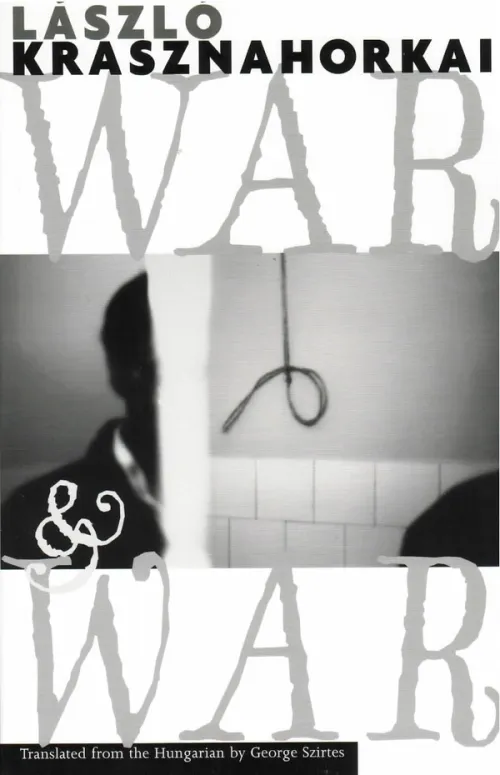
OK, trying to collect some thoughts on War and War.
The weird thing is, as much as I was blown away by it, there are some things about it that annoy me. For one thing, there's the same issue (if for a slightly different reason) that I had with Pale Fire: that feeling that there's no firm ground to stand on in the novel - it's all related through the eyes of someone who's not entirely reliable even to himself. There are times when I wonder if that's not a cop-out on behalf of the writer - if there's any part that doesn't quite work, you can always claim that he meant for it to not work since Korin's a bit of a nut even when he's at his most relatable and, well, US. This is especially obvious in the coda, where Korin sounds at times like a caricature of …
OK, trying to collect some thoughts on War and War.
The weird thing is, as much as I was blown away by it, there are some things about it that annoy me. For one thing, there's the same issue (if for a slightly different reason) that I had with Pale Fire: that feeling that there's no firm ground to stand on in the novel - it's all related through the eyes of someone who's not entirely reliable even to himself. There are times when I wonder if that's not a cop-out on behalf of the writer - if there's any part that doesn't quite work, you can always claim that he meant for it to not work since Korin's a bit of a nut even when he's at his most relatable and, well, US. This is especially obvious in the coda, where Korin sounds at times like a caricature of a reactionary conspiracy theorist (noble and transcendant and transcendant and noble and...)
Thing is, though, it does work. I'm still not sure the coda is strictly necessary, but it does cast the novel into a starker light, separates the shadows from the open spaces like an old expressionist movie, brings out the themes that were lurking just under the surface. There's the prose, those huge labyrintine sentences that take me days to even get a hang of (once I do, I zoom through the novel in a few marathon sessions); sentences that are cast into the general mess of life like fishing lines with hundreds of hooks, dragging anything they catch up to the surface. Bob Dylan once said that he wrote "A Hard Rain's A-Gonna Fall" because he didn't think he'd have time to write all the songs he wanted to, so he just let every idea he had form one line, one line that could be spun off into an entire story, and turned them all into one song; Krasznahorkai does something similar here, though possibly in reverse.
The underlying theme of transcendance is a tricky one; on the one hand, with the coda in mind, you have Korin answering his own question - what's left in the world - not by finding the story (if that were the point, we'd get to read the story ourselves) but by telling it, finding someone who'll listen to him as he tells it to himself and tries to imbue it with himself. Of course, it also means he withdraws from society, and ironically fails to save the person who's become his one and only audience... or himself, of course. Unless that's what he does. I mean, at least I'll never forget him.
...which, of course, accompanies the theme of all the various timeskips; all the great peace efforts built on methods that require war, all the great churches built on power, all the great discoveries leading to oppression... Yeah, the road to hell is paved with good intentions, that's not news, but I've rarely seen it explored this insidiously; that there is, to nod to Pynchon, an inherent vice in all of humanity. (There's a horror novel lurking under the surface here someplace, an almost Lovecraftian one... that'd make Korin the mad Arab, I guess, but I digress.)
And then there's the sheer beauty of it. I keep going back to Part VI, chapter 1, the scene where movers come and empty the flat and then fill it again whie Korin and Maria just watch in confusion. All according to some plan.
..until, about four o'clock, the men departed and suddenly there was silence in the apartment, at which point, seeking an explanation, they began tentatively to open the boxes.
It's not a perfect novel. It'd be a crime to inflict a perfect novel on an imperfect world. It is a great novel, though.
That's all I got right now. And I'm not sure about any of it, but at least I'm sure about that.