Björn recenserade Am Weltenrand sitzen die Menschen und lachen av Philipp Weiss
None
4 stjärnor
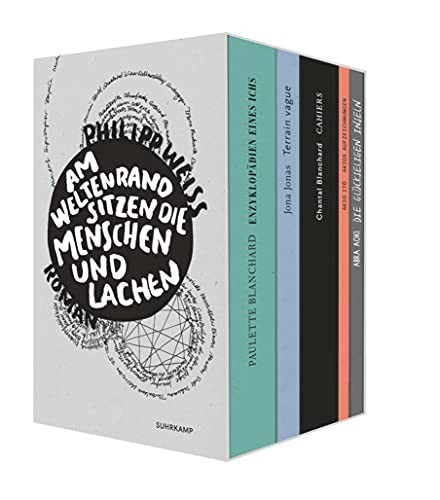
A debut novel, definitely. The kind that doesn't so much seem incomplete as wanting to do absolutely EVERYTHING at once. Am Weltenrand... takes us from the Paris commune to modern-day Tokyo, from the Big Bang to heat death, from struggle to nirvana, from the ascent of man to cyberpunk... and it does it by way of both Flaubert and Godzilla, quantum physics and Youtube comments, diaries and translations, etc etc etc. 1,000 pages, five separate texts, all masquerading as five very different kinds of autobiography, to be read in any order, supposedly influencing each other in different ways depending which order you pick...
And it almost pulls all of it off. And as bowled over as I am by the complete omnipedia of it, it's certainly not flawless. Comes with the territory, obviously.
German has a lot of words for "Why?". I love, as does Weiss apparently, the word "wozu?" …
A debut novel, definitely. The kind that doesn't so much seem incomplete as wanting to do absolutely EVERYTHING at once. Am Weltenrand... takes us from the Paris commune to modern-day Tokyo, from the Big Bang to heat death, from struggle to nirvana, from the ascent of man to cyberpunk... and it does it by way of both Flaubert and Godzilla, quantum physics and Youtube comments, diaries and translations, etc etc etc. 1,000 pages, five separate texts, all masquerading as five very different kinds of autobiography, to be read in any order, supposedly influencing each other in different ways depending which order you pick...
And it almost pulls all of it off. And as bowled over as I am by the complete omnipedia of it, it's certainly not flawless. Comes with the territory, obviously.
German has a lot of words for "Why?". I love, as does Weiss apparently, the word "wozu?" - "Where to?". To what purpose? Wither all this high-precision blather? And that's arguably the entire point, I guess. It's the fourth (in my case) text, Cahiers, that seems to unlock it all, and still leaves me a bit frustrated with where it goes - you want that "wozu" to have a destination, you want fiction to set up difficult questions and if not outright answer them, then at least develop them to some sort of conclusion. But if life - or indeed existence, on a personal, species, or even molecular level - doesn't have a simply defined purpose, where to go with that? Weiss is an extraordinary stylist, creating five very different narrators to attack his big questions (what is an "I", anyway? Can you reproduce it using text? Can you truly know yourself or anyone else? Can you even trust reality itself? Can you order chaos? Is love something actual?) using every trick modern printing practices will allow him; yet as thrilling, funny, heartbreaking, pageturning, maddening, annoying (there's a fair bit of orientalism here which I'm pretty sure is about 90% deliberate), baffling it is, he still gets hung up on one particular then-current event a little too much, still a little too much in love with his own conceit, still struggling a bit to fuse his intimate personal drama with his big lofty questions.
But really, those are minor complaints. This is definitely the biggest read of the year for me, and I plowed through it like obsessed. I'll always love something that shoots for the moon and misses by a few degrees more than something that's happy to stay where it is, and Weiss' mad dissection of the world is both a ton of fun and one of those headaches I can't get rid of. Wozu? Second electron to the right and straight on til morning.
Suggested reading order:
1. Enzyklopädien eines Ichs
2. Terrain vague
3. Die Glückseligen Inseln
4. Cahiers
5. Akios Aufzeichnungen