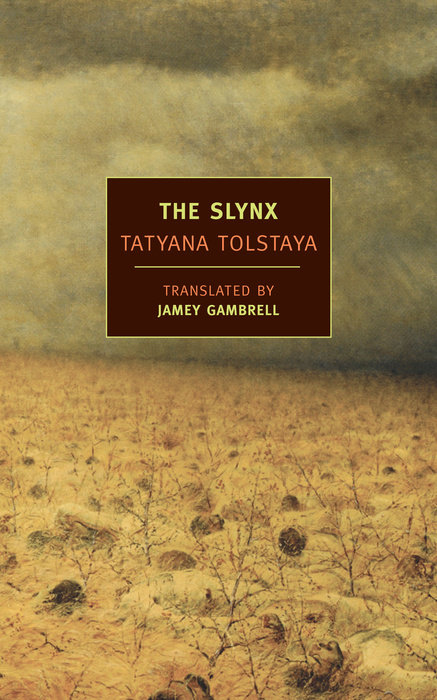
Björn recenserade The slynx av Tatʹi͡ana Tolstai͡a (New York Review Books classics)
None
3 stjärnor
"Aha. Apes don't read philosophy."
"Yes they do. They just don't understand it."
200 years after The Blast, people are trying to build some sort of civilisation in what used to be Moscow. Well, "people" is a loose term, since pretty much everyone has "consequences" of some sort; from the people who just have some weird boils, unusual hair growth or claws, to the ones who are used as pack animals. And of course the ones who were alive at the time of the Blast and whose "consequence" is that they can't die of old age, and who still occasionally mumble about weird things like party membership and solidarity and Lenin. All of them live off whatever mutated animals or plants turn out not to be deadly.
Then there's, inevitably, our hero, whose job it is to copy out old texts so they can be read, and who doesn't get …
"Aha. Apes don't read philosophy."
"Yes they do. They just don't understand it."
200 years after The Blast, people are trying to build some sort of civilisation in what used to be Moscow. Well, "people" is a loose term, since pretty much everyone has "consequences" of some sort; from the people who just have some weird boils, unusual hair growth or claws, to the ones who are used as pack animals. And of course the ones who were alive at the time of the Blast and whose "consequence" is that they can't die of old age, and who still occasionally mumble about weird things like party membership and solidarity and Lenin. All of them live off whatever mutated animals or plants turn out not to be deadly.
Then there's, inevitably, our hero, whose job it is to copy out old texts so they can be read, and who doesn't get why until he discovers a real library. And then he reads. And he reads and he reads and he reads and he devours the books and he's ... still kind of an idiot because he doesn't get them.
It's a paean to the undiscerning reader, but not a simple one; there's a healthy dose of irony in it, in that it's also a story of a society that reveres books as artefacts or status symbols but fears what they might do in the wrong hands, and certainly doesn't write any new ones, thankyouverymuch. The current strongman takes credit for Gogol, for Dostoevsky, for everything, and doesn't even understand what the books his subjects praise him for mean.
(I'm reminded of Alexievich's Second Hand Time and this passage:
They used to send you to jail over The Gulag Archipelago. You read it in secrecy, copying it on typewriters or by hand. I thought ... I thought that if thousands of people read it, things would change. There'd be repentance and tears. And what happened? Everything hidden in desk drawers was brought out and printed, everything thought in secret was said allowed. And?! Now the books collect dust on the tables. And people just hurry past ... (Trails off.))
The Slynx is such an intriguing novel that I feel bad for not liking it more than I do. It takes me ages to find the groove in it, and when I do I almost want to go back and revisit it to see what I missed at first among all those disjointed images of a post-apocalyptic post-Russia. Maybe someday I will. Until then, I'm keeping it in my library for future generations.