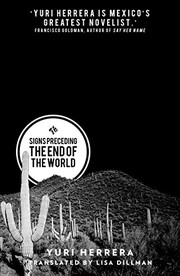
Björn recenserade SIgns proceeding the end of the world av Yuri Herrera
None
5 stjärnor
"The end of the uni-verse" (translator's note)
I read two excellent Mexican novels in 2015; Jennifer Clement's Prayers for the Stolen; and this one. Both are similar, and yet very different; they both concern the border, the idea of different worlds, the violence of a male society ruled by guns and the knowledge that nobody dies peacefully of old age, and how women survive in it.
The difference: Clement writes (brilliantly) about a world which is, Herrera writes of one that becomes. It's a subjective, subjunctive novel.
Using in one tongue the word for a thing in the other makes the attributes of both resound: if you say Give me fire when they say Give me a light, what is not to be learned about fire, light and the act of giving? It's not another way of saying things: these are new things. The world happening anew, …
"The end of the uni-verse" (translator's note)
I read two excellent Mexican novels in 2015; Jennifer Clement's Prayers for the Stolen; and this one. Both are similar, and yet very different; they both concern the border, the idea of different worlds, the violence of a male society ruled by guns and the knowledge that nobody dies peacefully of old age, and how women survive in it.
The difference: Clement writes (brilliantly) about a world which is, Herrera writes of one that becomes. It's a subjective, subjunctive novel.
Using in one tongue the word for a thing in the other makes the attributes of both resound: if you say Give me fire when they say Give me a light, what is not to be learned about fire, light and the act of giving? It's not another way of saying things: these are new things. The world happening anew, Makina realizes: promising other things, signifying other things, producing different objects. Who knows if they'll last, who knows if these names will be adopted by all, she thinks, but there they are, doing their damnedest.
A simple story: Makina (as in deus ex?) lives in a small town in Mexico, ruled by gangs. She has to cross the border into the US to bring back her brother, who left years ago to reclaim something that was supposed to be legally theirs, and never came back. She has to make deals to get there, but what's more, she has to transform. What she is at home isn't what she is over there. Then again, is anyone?
Signs... is a novel of language; Herrera bombards the reader with worlds... sorry, words that are pregnant with concepts, that frequently fit together in new ways. There's plenty of dialogue but no speech markers; there's no wall between the narrative and the people caught within it, whatever they may think when they look at each other or try to figure out which language to use. At the centre is that neologism jarchar - to verse in Lisa Dillman's (excellent, and appropriately subversive) translation - a verb meaning to exit, to cross, to transgress, to pass, to stand out, to counterpoint, to become a story. The act of leaving, entering somewhere new, changes not just the one who leaves and enters but the story around them. Makina is one of the most memorable characters I've read all year, even though (or perhaps because) both because of who she is and who she becomes as the story mutates around her. All that bullshit about "strong female characters" that all too often means physically strong; she's one of those who can recognize the story around her and make her mark on it, who can gaze - and let the reader gaze - into all those layers of thatsjustthewayitis and slip between them.
We are to blame for this destruction, we who don’t speak your tongue and don’t know how to keep quiet either. We who didn’t come by boat, who dirty up your doorsteps with our dust, who break your barbed wire. We who came to take your jobs, who dream of wiping your shit, who long to work all hours. We who fill your shiny clean streets with the smell of food, who brought you violence you’d never known, who deliver your dope, who deserve to be chained by neck and feet. We who are happy to die for you, what else could we do? We, the ones who are waiting for who knows what. We, the dark, the short, the greasy, the shifty, the fat, the anemic. We the barbarians.
That title; much like another novel set in the Mexican borderlands, the end of the world seems a given; always in gerund, never in the present or future tense. Then again, someone with a passing knowledge in mythology knows that the calendar always starts over again after each apocalypse, and new things rise from the old. Go, then; there are other worlds than this.
/December 2015
Reread 21/11/16 in Swedish. Still great, but the Swedish translation completely ditches the "verse"/"jarchar" thing which disappoints me a bit.