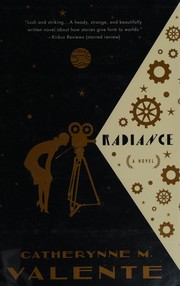
Björn recenserade Radiance av Catherynne M. Valente
None
5 stjärnor
Something was lost when movies started talking. Yes, a lot of silent movies are hopeless melodramas, overacted with simplistic plots that can be carried by intertitles. But to the greatest of the silent directors - yer Sjöströms, yer Murnaus, yer Vertovs, yer Langs, yer von Stroheims, yer Dreyers, and of course yer Mélièses - there was a poetry to it, a freedom to dip directly into that thing beyond plot, into the dream that gave rise to the moving image in the first place, that disappeared among clumsier cameras, stricter guidelines, tighter plots and louder stars. Endless possibilities unfettered by anything so prosaic as spoken language.
That's not what this book is about.
Let's see, it starts with ... No, I can't do that. The problem with a story, as soon as you hand it to a movie studio, is that the beginning is always so nebulous, it changes with …
Something was lost when movies started talking. Yes, a lot of silent movies are hopeless melodramas, overacted with simplistic plots that can be carried by intertitles. But to the greatest of the silent directors - yer Sjöströms, yer Murnaus, yer Vertovs, yer Langs, yer von Stroheims, yer Dreyers, and of course yer Mélièses - there was a poetry to it, a freedom to dip directly into that thing beyond plot, into the dream that gave rise to the moving image in the first place, that disappeared among clumsier cameras, stricter guidelines, tighter plots and louder stars. Endless possibilities unfettered by anything so prosaic as spoken language.
That's not what this book is about.
Let's see, it starts with ... No, I can't do that. The problem with a story, as soon as you hand it to a movie studio, is that the beginning is always so nebulous, it changes with each rewrite, with each new character brought on board.
It ends here: IN A WORLD nope, can't do that, you need a voiceover. Besides, there's only one world, isn't there?
It ends here: A film crew come to Venus - which, as we all know, was colonised in the late 1800s - to make a documentary about the mysterious disappearance of a small fishing village. The director: A young woman, the daughter of one of the great early directors who transformed the moon into one huge movie set (all in high-contrast black and white, of course), who's grown to hate her father's silly space dramas and just wants realism, true stories, and yes, even the SOUND of her own voice, even though everyone knows real movies are supposed to be silent. Things, as they are wont to do in space dramas, go Very Very Wrong. But of course, what's an ending without a story, so after enough years have passed, her father tries to tell that story.
Radiance is a remarkable book; a poem, a fairytale, not remotely science fiction in the sense that anything here is plausible; it lives in a world where mankind easily spreads across the solar system via rocketships fired out of cannons, where every planet is full of colourful flowers and strange animals but (probably) no intelligent life but our own, where old-time radio dramas and silent b&w movies are broadcast to the moons of Jupiter, where Charon and Pluto are connected by a bridge trafficked by stagecoach. And we get dropped into this by the means of camera lenses, gossip columns, movie scripts, interviews, diaries and interrogation records, trying to piece together not only what happened to Severine Unck and her film crew, but what it means. Because nothing is real if it's not recorded, but as any film director will tell you, anything that gets recorded (even documentaries? Especially documentaries) becomes artifice the second you yell "CUT!" Or was it "ACTION!"? You know, kind of like how if we find a huge aquatic animal on Venus, we're going to call it a whale even if it's not technically a cetacean; it fits the story we know. We think. It's the beauty of cinema: Anyone can play any part, with the right script and a clever enough crew making it look right. And sure the actual flesh-and-blood people get used up and shat out and hurt and heartbroken, but honestly, who cares what happens when the camera's off?
In the place I am showing you, no one can live anywhere but Earth.
Oh... Oh, God. What an awful, lonely place. How can a place like that be? How can they bear it?
Have you ever seen a movie?
I've never read Valente before but I'm going to have to read more of her. She bases this story (has her characters base their takes on the story) on so many sources, on tales old and new (and as we all know, fairytales are very old indeed), twisting them around each other until they bleed up new ones, throwing us from noir to space opera to murder mysteries to animated children's stories without missing a beat, but without ever getting to close to the ONE story, the ONE explanation, the ONE perspective that will supercede all others. It's a sheer delight to read, an explosion of imagination that never forgets that the almighty Power Of Stories bullshit can awake things you can't control.