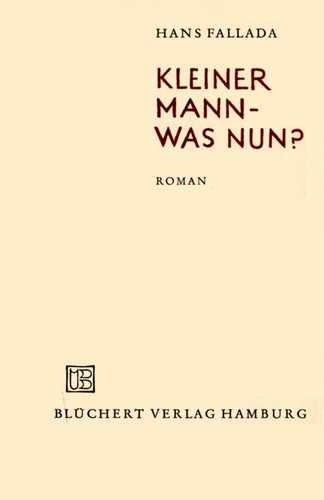
Björn recenserade Kleiner Mann - was nun? av Hans Fallada (Atb, #2676)
None
5 stjärnor
The book is written in Germany of 1932. One year before Hitler came to power.
I first read this in Swedish a few years ago. The Swedish title, What'll Become Of The Pinnebergs? is a bit cheesy; it sounds a bit like a 30s comedy, which of course it is in a way, but it doesn't seem to have the weight of the original's Little Man, What Now? At the same time I can't help but like the title, as if it's setting us up less to see a warning (which it is) and more to see the people in it, as a (which it also is) nice, low-intensity but increasingly desperate story about a young family just trying to get along.
Start from the beginning: Johannes Pinneberg marries Emma "Lämmchen" ("Little lamb") Mörschel. They hadn't really planned to get there this quickly, but they're young, they forget about contraception, …
The book is written in Germany of 1932. One year before Hitler came to power.
I first read this in Swedish a few years ago. The Swedish title, What'll Become Of The Pinnebergs? is a bit cheesy; it sounds a bit like a 30s comedy, which of course it is in a way, but it doesn't seem to have the weight of the original's Little Man, What Now? At the same time I can't help but like the title, as if it's setting us up less to see a warning (which it is) and more to see the people in it, as a (which it also is) nice, low-intensity but increasingly desperate story about a young family just trying to get along.
Start from the beginning: Johannes Pinneberg marries Emma "Lämmchen" ("Little lamb") Mörschel. They hadn't really planned to get there this quickly, but they're young, they forget about contraception, and whoops. No big, these are modern times and it's not that much of a moral issue. They're well into their 20s, they already have jobs (though of course she'll have to quit hers), they were going to end up here anyway, now they just have just under 9 months to get their proper adult married lives in order before the little one arrives. They're in love, they're willing to work hard, they don't demand any luxury... What could possibly go wrong?
Well, there's the bit about getting started. If you want to feed three mouths on one salary, you need to save money. To save money, you need to have money. If you can't afford to buy your own place, you need to rent expensive furnished rooms, and they don't want squalling newborns. You need a fixed income, but the economy is hurting and if you don't like the deal, there are thousands of others who want your job, and...
(...and there's political unrest brewing in the background, communists and Nazis fighting in the streets, and say what you want about the Nazis, they may be violent thugs but at least they're OUR violent thugs, good German boys who are bound to grow up if we just show them some respect, and let's be honest, nobody likes the Jews, so we'll see after the election...)
The book is written in Germany of 1932. One year before Hitler came to power.
And Pinneberg works and toils but he can't get ahead, he clings to any job he can get by his fingernails, locked in competition with his co-workers. They're in a recession, and you know the business owners are hurting too, what with the taxes and all, and they'd love to offer better wages but &c. Don't cause any trouble, keep your head down, don't come across as political by demanding more than what we say is your share, you'll get pie in the sky when you die. Emma's class-conscious worker parents sneer at her for "marrying up", Johannes' aging madam of a mother can't understand why they're so hung up on something as hopelessly common as money. All Johannes and Emma ask is to love and earn their keep, but anything they can say or do is turned against them. Pride fucks with ya; nobody likes a beggar, but what to do when you're reduced to asking for mercy? The harder society becomes, the more we hate the weak, the weakness in ourselves.
Down the slippery slope, sunk without trace, utterly destroyed. Order and cleanliness, gone; work, material security, gone; making progress and hope, gone. Poverty is not just misery, poverty is an offence, poverty is a stain, poverty is suspect.
And yet Fallada describes them with such warmth and wide-eyed optimism, as if he can't bear the thought that it's hopeless even as he piles on the misfortune and they increasingly lose their grip on that steep, slippery slope. He describes their lives so simply, so matter-of-factly that he never lets us forget that this is happening NOW - in the 30s, sure, but that wasn't long ago, this isn't some weird mediaeval Dickens world, these are two young people in 20th century Europe. They're in love. They have no money. They're slipping, and they can't hold on. And they're not alone, and fear and paranoia is spreading, and SOMETHING is going to happen to society very soon.
And it breaks my heart, and leaves me fucking furious that I know what'll become of the Pinnebergs. Whatever they ended up doing over the next 15 years, they became part of that thing that we've been so busy arguing that it can never happen again that we completely ignore any hint that it can, as if "Never Again" were some magical formula. Nobody saw it coming that time, so common wisdom states... Except for Fallada and other writers, obviously... So clearly we'll see it coming next time, right? Increasing inequality, rising unemployment, fear, xenophobia, more people running to extremist parties, that's all stuff that just kind of happens in 2014. Germany of 1932 was long ago.
And yet I read this book and I love it, I can almost forget what I know, I can read it and see that question mark at the end of the title. The book is so now, and the Pinnebergs so multi-faceted and so trusting in each other and believing that somehow it has to work out, there's simply no other option, that I want to believe it. Fallada didn't know; he could suspect, but he could hope. He could be as naive as Johannes and Emma are at the start. Because really, what else is there?
The book is written in Germany of 1932. It sold massively, was serialized all over Europe, became the 1930s version of Orange Is The New Black, was discussed everywhere. Then Hitler took over anyway. The pen didn't stand a chance against the sword.
Little man... what now?