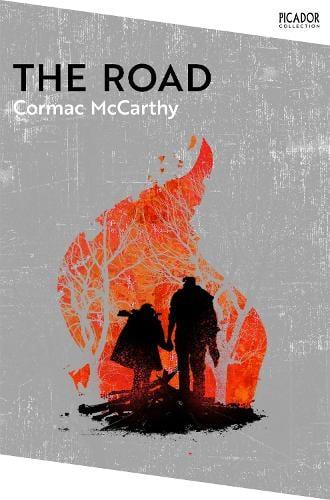
A father and his son walk alone through burned America. Nothing moves in the ravaged landscape save the ash on the wind. It is cold enough to crack stones, and when the snow falls it is gray. The sky is dark. Their destination is the coast, although they don’t know what, if anything, awaits them there. They have nothing; just a pistol to defend themselves against the lawless bands that stalk the road, the clothes they are wearing, a cart of scavenged food—and each other. --back cover
A father and his son walk alone through burned America. Nothing moves in the ravaged landscape save the ash on the wind. It is cold enough to crack stones, and when the snow falls it is gray. The sky is dark. Their destination is the coast, although they don’t know what, if anything, awaits them there. They have nothing; just a pistol to defend themselves against the lawless bands that stalk the road, the clothes they are wearing, a cart of scavenged food—and each other.
--back cover
Well written and propulsive, but grim as, without much payoff? Who were the “good guys” and how were they able to survive, and why were they good?- it cannot just be a matter of not eating other humans. One review on the back of the book stated that it “serves as a warning”, but for what? Climate change? How, when everything was burned, were there still houses standing? I dunno, maybe post apocalyptic literature is just not my jam.
I started reading because I was drawn to a story that seemed somewhat similar to The Last of Us. However, I found that The Road is even deeper and more complete, particularly due to the dynamic between the father and son. Perhaps it resonated with me so much because my youngest son is only four years old.
Je ne me risquerai pas à une critique de La Route, tant elles sont nombreuses et dithyrambiques.
Ce n'est pas de la science-fiction. Ce n'est pas une dystopie. Ce n'est pas de la poésie. Ce n'est pas un thriller. Ce n'est pas un roman d'aventure. Ce n'est pas une réflexion philosophique. Sans classement possible, c'est un peu de tout cela à la fois.
Je ne me risquerai pas à une critique de La Route, tant elles sont nombreuses et dithyrambiques.
Ce n'est pas de la science-fiction. Ce n'est pas une dystopie. Ce n'est pas de la poésie. Ce n'est pas un thriller. Ce n'est pas un roman d'aventure. Ce n'est pas une réflexion philosophique. Sans classement possible, c'est un peu de tout cela à la fois.
Cormac McCarthy weiß, was er tut und das ist das Problem mit diesem Buch. Die graue, verbrannte Welt erwacht zum Leben, der Vater und sein Junge treten einem zu nahe, dass man es ertragen kann. Der Subtext explodiert, während McCarthy sich mit den Worten zurückhält, und so tauch man vollkommen in die Hoffnungslosigkeit ein. Er weiß, wie man die Leserschaft fesselt an diese emotional aufwühlende Irrfahrt durch die Postapokalypse. Ein wenig zu lang leidet man mit den Protagonisten, bis man zermürbt am Ende des Buchs ankommt. Der Schrecken gedeiht in dieser Welt ungehemmt und selbst mit Kleinkindern hat McCarthy keinerlei Gnade. Wer keine Angst vor einer bewegenden Geschichte und viel emotionale Kapazität hat, soll die Straße lesen, doch gerade Eltern seien gewarnt, dass dies ein Horrorbuch ist.
Can I use "harrowing" as a verb rather than an adjective? "This book harrowed me"?
tr.v. har·rowed, har·row·ing, har·rows 1. To break up and level (soil or land) with a harrow. 2. To inflict great distress or torment on.
I'm asking for two reasons. One, because, well, it did. The Road is the kind of book that really rips you up, not just on the surface. It doesn't actually plant seeds, but it makes it easier for them to take root - post-apocalyptic barrenness and a few small gripes I had with the book notwithstanding.
The other reason is one of the things that strike me about it: the near-extinction not only of mankind, but of humanity. Of language, which dies along with our need for it. The prose is spare - beautiful, but spare - because it needs to be. So many of the words, the concepts, the man …
Can I use "harrowing" as a verb rather than an adjective? "This book harrowed me"?
tr.v. har·rowed, har·row·ing, har·rows 1. To break up and level (soil or land) with a harrow. 2. To inflict great distress or torment on.
I'm asking for two reasons. One, because, well, it did. The Road is the kind of book that really rips you up, not just on the surface. It doesn't actually plant seeds, but it makes it easier for them to take root - post-apocalyptic barrenness and a few small gripes I had with the book notwithstanding.
The other reason is one of the things that strike me about it: the near-extinction not only of mankind, but of humanity. Of language, which dies along with our need for it. The prose is spare - beautiful, but spare - because it needs to be. So many of the words, the concepts, the man remembers make no sense anymore. He can't explain phrases like "in the neighbourhood" or "as the crow flies" to the boy; those very simple concepts are as dead as the more abstract ones - you know, compassion, selflessness, justice, that lot - seem to be. (Though one thing that really chilled me was not just the cruelty of men to each other, but how they keep finding unlooted stores, spilled money, high-tech wrecks. As if all of mankind has realized that the world isn't coming back. No one bothers looting for anything except food and clothing to postpone the inevitable.
And in a sense, that's part of the problem I have with the book. I'm not going to complain specifically about the religious or socioeconomic references, but the fact that the book is so obviously set up to be a parable and nothing falls outside that. It's sort of what John Self said above: that every line seems designed to tug at your heart strings, everything is tied into the symbolism of the piece. Not ONE person does anything unexpected once their character has been set up, everyone goes out of their way to be a part in the bleak picture McCarthy wants to paint. Which is not really a big problem when he does it this well, it's just... I dunno, I'd think the last thing that dies with humanity would be our irrationality. It only takes ONE person to loot a store. It only takes ONE cut on a poorly shod foot to give a kid blood poisoning. etc. None of that happens here, because that's not what McCarthy wants to happen.
That's a small gripe, though. The book moves, groans, shudders and shakes like few other post-apocalyptic tales I've read. It's biblical, not in the sense of "I know Jesus loves me" but in the way it feels like it's a story that's engrained, that everyone knows at 3 AM when they can't sleep, that everyone goes through in some way. I'm reminded of Mary Shelley's masterful The Last Man, though obviously McCarthy has done away with her early 19th-century romanticism. And I'm thinking of a Bob Dylan song:
Ain't talkin' Just walkin' Up the road, around the bend Heart burnin' Still yearnin' In the last outback at the world's end
Except that song is 8 1/2 minutes of nothing but talking. The words just keep coming, even if they don't matter anymore, one foot in front of the other, on and on. Just like the man and the boy keep walking long after it's obvious that there is no unspoiled paradise at the end of the road. As if we don't lose until we admit defeat.
The man remakes God in his own image, that of his son, and gives his life to protect it.
Dylan's song kills everything worth hoping for, then ends on a major chord after chugging along in a minor key all the way. The last thing that dies is not hope.