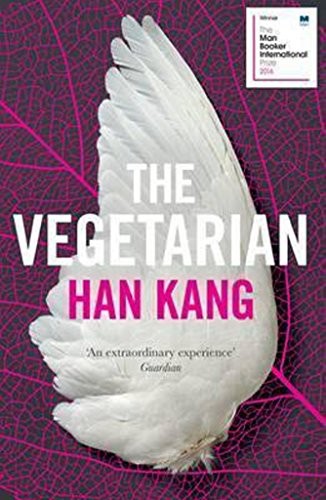
Yeong-hye and her husband are ordinary people. He is an office worker with moderate ambitions and mild manners; she is an uninspired but dutiful wife. The acceptable flatline of their marriage is interrupted when Yeong-hye, seeking a more 'plant-like' existence, decides to become a vegetarian, prompted by grotesque recurring nightmares. In South Korea, where vegetarianism is almost unheard-of and societal mores are strictly obeyed, Yeong-hye's decision is a shocking act of subversion. Her passive rebellion manifests in ever more bizarre and frightening forms, leading her bland husband to self-justified acts of sexual sadism. His cruelties drive her towards attempted suicide and hospitalisation. She unknowingly captivates her sister's husband, a video artist. She becomes the focus of his increasingly erotic and unhinged artworks, while spiralling further and further into her fantasies of abandoning her fleshly prison and becoming - impossibly, ecstatically - a tree. Fraught, disturbing and beautiful, The Vegetarian is …
Yeong-hye and her husband are ordinary people. He is an office worker with moderate ambitions and mild manners; she is an uninspired but dutiful wife. The acceptable flatline of their marriage is interrupted when Yeong-hye, seeking a more 'plant-like' existence, decides to become a vegetarian, prompted by grotesque recurring nightmares. In South Korea, where vegetarianism is almost unheard-of and societal mores are strictly obeyed, Yeong-hye's decision is a shocking act of subversion. Her passive rebellion manifests in ever more bizarre and frightening forms, leading her bland husband to self-justified acts of sexual sadism. His cruelties drive her towards attempted suicide and hospitalisation. She unknowingly captivates her sister's husband, a video artist. She becomes the focus of his increasingly erotic and unhinged artworks, while spiralling further and further into her fantasies of abandoning her fleshly prison and becoming - impossibly, ecstatically - a tree. Fraught, disturbing and beautiful, The Vegetarian is a novel about modern day South Korea, but also a novel about shame, desire and our faltering attempts to understand others, from one imprisoned body to another.
Un libro que no parece ser lo que se presenta. Tiene tres elementos bastante delimitados con respecto al ser humanos: un elemento superficial, otro más carnal y el último, más mental. A Freud le hubiese gustado.
Otroligt vacker bok, med målande beskrivningar. Realism och surrealism på samma gång. Kommer att läsa om framöver, känns som det finns mycket att finna i texten som kanske inte kommer fram direkt.
Otroligt vacker bok, med målande beskrivningar. Realism och surrealism på samma gång. Kommer att läsa om framöver, känns som det finns mycket att finna i texten som kanske inte kommer fram direkt.
This was a difficult book to finish. I wanted to finish it, for about a week, but the last 50 or so pages are emotionally harrowing. Hard work.
Stylistically beautiful. Terse and without any extraneous detail, it reads a bit like a ascetic philosophical exploration of decisions in society.
A lot of other reviews (and the blurb above) focus on the book's setting in Korea -- traditionally meat-heavy diet, traditionally rigid patriachal family structure etc. I didn't find this -- apart from the names of people (which are few) and the descriptions of food, there is very little to locate this book in space or time beyond being somewhat modern.
This was a difficult book to finish. I wanted to finish it, for about a week, but the last 50 or so pages are emotionally harrowing. Hard work.
Stylistically beautiful. Terse and without any extraneous detail, it reads a bit like a ascetic philosophical exploration of decisions in society.
A lot of other reviews (and the blurb above) focus on the book's setting in Korea -- traditionally meat-heavy diet, traditionally rigid patriachal family structure etc. I didn't find this -- apart from the names of people (which are few) and the descriptions of food, there is very little to locate this book in space or time beyond being somewhat modern.
...was the headline in Swedish newspapers when The Vegetarian won the Booker last year. Not that all those papers had read the book, obviously, quite the contrary (though it will be out in Swedish in a month or so, but sadly translated from the excellent English translation rather than from Korean, which is a whole other thing). But someone at the news agency spent five seconds reading a synopsis of the book and learned that there was a sex scene and that there was a woman transforming herself into a tree, drew his (or possibly her, but let's play the odds) own conclusions about what the book might contain, put a click-friendly headline on it and put it out there, and all the newspapers who hadn't read the book reprinted the item as it was. And hey presto, Han Kang was now a vegetable pornographer …
PLANT PORN WINS BOOKER PRIZE
...was the headline in Swedish newspapers when The Vegetarian won the Booker last year. Not that all those papers had read the book, obviously, quite the contrary (though it will be out in Swedish in a month or so, but sadly translated from the excellent English translation rather than from Korean, which is a whole other thing). But someone at the news agency spent five seconds reading a synopsis of the book and learned that there was a sex scene and that there was a woman transforming herself into a tree, drew his (or possibly her, but let's play the odds) own conclusions about what the book might contain, put a click-friendly headline on it and put it out there, and all the newspapers who hadn't read the book reprinted the item as it was. And hey presto, Han Kang was now a vegetable pornographer without anyone having asked her about it.
"I had a dream."
There's a metaphor in that which works rather deliciously for this story about a woman whom nobody has asked about, well, anything, ever. Her decision to stop eating meat, then to stop eating altogether, and then to stop being a woman (with all that that entails in a world not run by women) has an explanation, but whenever she (at first) tries to explain it, nobody's interested. Look at how she's embarrassing her husband, her father, her family. Why can't she just be NORMAL? Kill things and eat them. Take your place in the chain of violence inherent in the system. Be something we can classify.
"I'm tired... I said I'm really tired." "Just put up with it for a minute," he said.
The Vegetarian, of course, is neither plant nor porn. It may well be perverse, but that's another thing entirely. Like a feminist Cronenberg adapting Bartleby The Scrivener (and it is very cinematic despite its short length), she tracks Yeong-hye's gradual descent or ascent (whichever it might be) through the eyes of others - her husband, her brother-in-law, her sister - but never letting the reader in on the answer, letting them draw their own conclusions. I'm still not sure what mine are, I'll have to mull this over. But damn.
ETA 17/1/26: Two thoughts after seeing Han Kang talk about this and Human Acts tonight: 1) She talks a lot about acts as defining who people are - the title of the latter novel is not hers but her English editor's, but it really suits her. 2) When asked about Yeong-hye's motivations and whether she's insane or just too sane, she stresses that there's a reason she never gives us Yeong-hye's POV, but just those of three people close (or at least near) to her; much like they project their reactions onto Yeong-hye's choice to NOT, she forces the reader to do the same thing. My reaction: Damn, she makes me as a reader complicit in the violence against a character who wants to categorically reject all violence - even the violence of having to put her decision into words, into explanations that can be accepted.
ETA 25/08/22: The idea of refusing the violence of society? How does one NOT be a human? What actions can one take to get out of it? What does the dream mean? How does each new novella build on the previous - do we understand more or less by the end than we did by the first third?